
Dec
Buying flowers should be simple, but the number of choices can make it surprisingly difficult. Should you choose roses or a mixed bouquet? Are imported flowers worth paying more for? How can you tell whether a bouquet is genuinely fresh? Does a larger bouquet automatically make a better gift?
The answers depend less on following rigid flower rules and more on understanding the recipient, occasion, freshness, availability, budget, and delivery conditions.
Start With the Recipient, Not the Flower
If you already know someone’s favourite flower, colour, or style, use that information before relying on conventional flower symbolism.
Someone who loves sunflowers may appreciate them more than a dozen red roses, even on an anniversary. A person who prefers understated gifts might enjoy a small arrangement of white and pastel flowers more than an oversized bouquet.
Consider:
- Their favourite flowers and colours.
- Their personality and personal style.
- Your relationship with them.
- The message you want the flowers to communicate.
- Where they will receive and display the bouquet.
- Whether strong fragrances could bother them.
Current florist guidance similarly recommends prioritising personal preference rather than treating occasion-based rules as absolute.
Choose the Bouquet According to the Occasion
Once you’ve considered the recipient, use the occasion to narrow your choices.
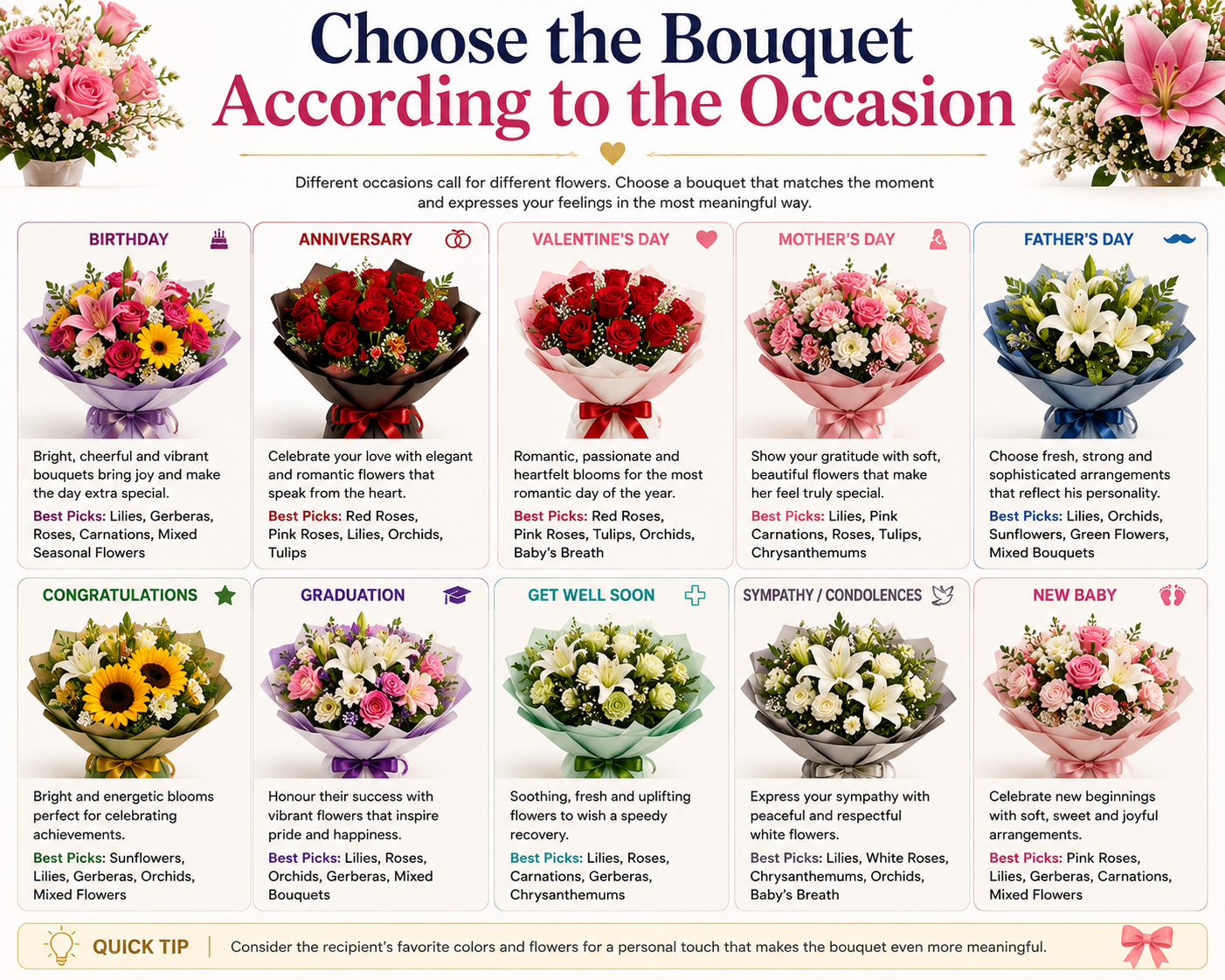
For Birthdays
Birthday flowers don’t require a particular variety.
Bright mixed bouquets containing combinations of roses, chrysanthemums, lilies, carnations, sunflowers or other available seasonal flowers work particularly well when you don’t know the recipient’s favourite flower.
You can make the gift more personal by choosing their favourite colour rather than relying on a conventional “birthday bouquet.”
For Anniversaries
Roses remain a classic anniversary choice, particularly when the relationship is romantic.
However, an anniversary bouquet doesn’t have to be red. Pink roses, white roses, lilies, tulips, orchids and mixed arrangements can work equally well if they better reflect your partner’s preferences.
For a spouse, remembering a flower used at your wedding or given earlier in your relationship can make the bouquet more personal than simply buying the largest arrangement available.
For Valentine’s Day
Red roses have a long-established association with romantic love and remain an obvious Valentine’s choice.
But they’re not mandatory.
Pink roses, tulips, lilies, orchids or combinations of red, pink and white flowers can provide alternatives.
Valentine’s Day is also one occasion where ordering early matters. Demand concentrates around a single date, so flower selection and delivery capacity may become more limited as the day approaches.
For Mother’s Day
Consider your mother’s preferences first.
Roses, carnations, lilies, chrysanthemums and mixed seasonal bouquets can all work. Softer pink, white, peach and pastel arrangements are common choices, but there is no reason to avoid brighter colours if she prefers them.
For Congratulations and Graduation
These occasions suit energetic colours.
Sunflowers, colourful roses, chrysanthemums, lilies and mixed arrangements can create a celebratory appearance without carrying an overtly romantic message.
For Weddings and Engagements
Flowers for weddings require a slightly different approach because they often need to coordinate with clothing, venue décor and an overall colour palette.
Seasonal availability should also be discussed with the florist rather than insisting on a specific flower regardless of availability—advice echoed in professional wedding-flower guidance.
Don’t Treat Flower Meanings as Rules
Flower symbolism can make a gift more interesting, but meanings vary across cultures and historical periods.
Common modern associations include red roses with romantic love, pink roses with admiration or affection, white flowers with simplicity or remembrance, and sunflowers with warmth and cheerfulness.
Treat these associations as inspiration rather than universal facts.
If someone’s favourite flowers happen to contradict a traditional interpretation, their preference should win.
Choose the Right Bouquet Style
The flowers themselves aren’t the only decision.
Hand-Tied Bouquets
A florist arranges the stems together and secures them before wrapping.
These work well when the recipient already owns a vase and you want the flowers themselves to remain the focus.
Wrapped Bouquets
Flowers are protected with decorative paper or other wrapping materials.
They’re convenient for birthdays, anniversaries and surprise deliveries because they arrive ready to present.
Flower Boxes
Flowers can also be arranged inside decorative boxes.
They provide a different presentation style and can be useful when presentation is as important as the flowers themselves.
Mixed Bouquets
Mixed arrangements combine several flower varieties, colours, textures and often greenery.
They’re particularly useful when you want something colourful but aren’t committed to one flower.
Single-Flower Bouquets
Instead of mixing varieties, the entire bouquet centres on one flower—such as roses, tulips or sunflowers.
These arrangements can appear cleaner and more deliberate, especially when the recipient has a favourite flower.
How to Tell Whether Flowers Are Fresh?
This is one of the most useful skills a flower buyer can learn.
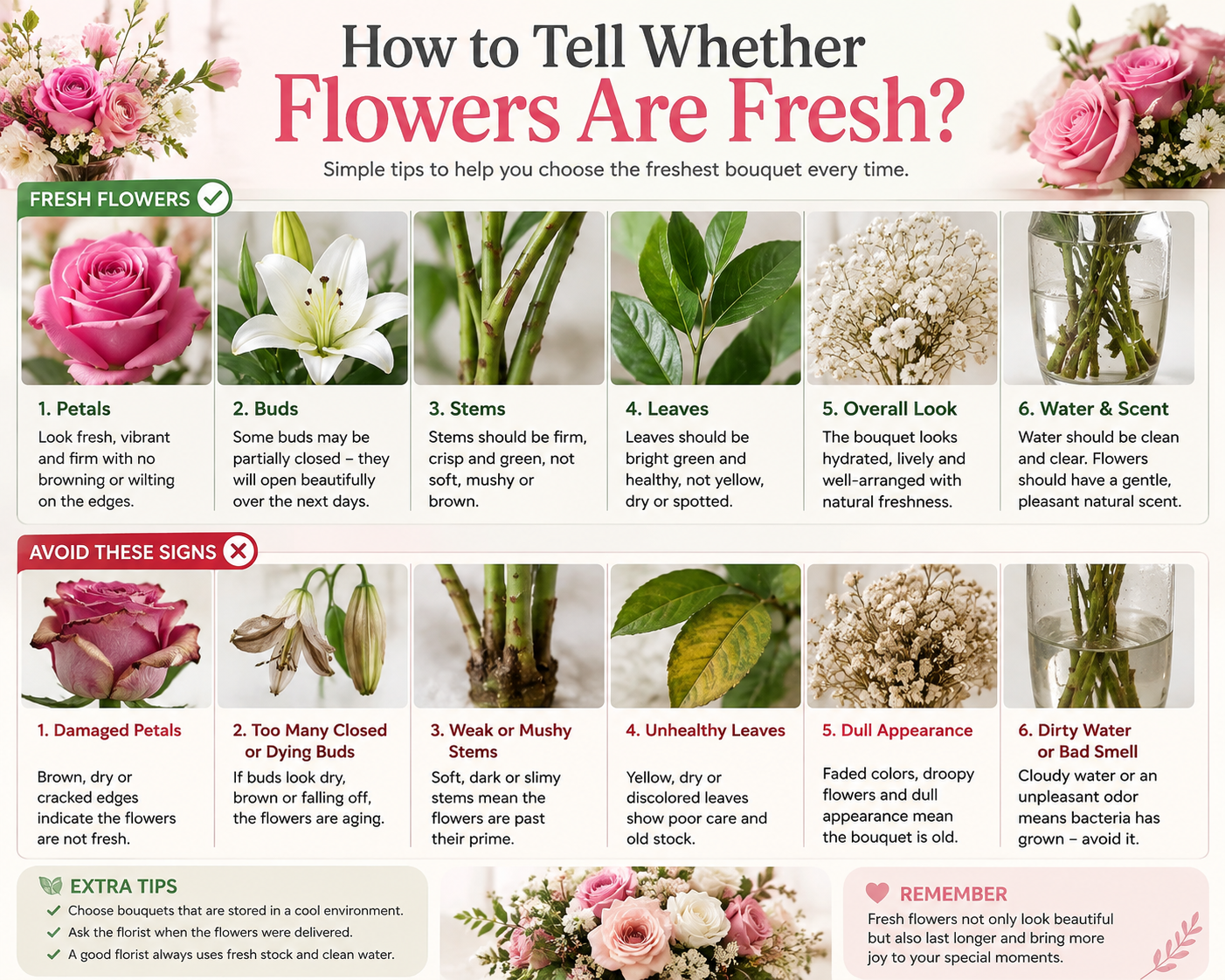
When inspecting flowers in person, look beyond whether the bouquet appears attractive from a distance.
Healthy cut flowers should generally have firm stems, good colour and petals without extensive bruising, wilting or shedding. Slimy stem bases and dirty holding water are warning signs.
Don’t automatically reject unopened flowers either.
Some flowers are intentionally supplied before they’re fully open so they can continue developing after purchase. The Royal Horticultural Society specifically notes that roses harvested too early may fail to open properly, illustrating why the correct maturity stage and development, rather than simply “closed buds = fresher,” matters.
When buying online, you obviously can’t inspect individual stems beforehand. That’s why retailer reputation, realistic product photographs, substitution policies and delivery practices become more important.
Local vs. Imported Flowers: Which Should You Buy?
“Imported” should not automatically be interpreted as “better.”
A locally grown flower that was cut recently and handled correctly can outperform an imported flower that has spent considerably longer travelling through the supply chain.
Imported flowers still have an important advantage: choice. They can give florists access to varieties, colours, stem lengths or specifications that aren’t readily available locally.
Instead of choosing based purely on origin, ask:
Which option is freshest and best suited to my budget and occasion today?
A good florist should be able to recommend accordingly.
Seasonal Availability Matters
Flowers are agricultural products rather than factory-made goods with identical year-round availability.
Growing conditions, season, weather, supply chains and demand influence what florists can source at any given time. The RHS likewise notes that flowering times vary across annuals, perennials, bulbs, shrubs and other plants.
This matters when ordering in Pakistan.
If an exact variety isn’t readily available, insisting on it may increase the price or require substitution. Giving the florist some flexibility can produce a better bouquet within the same budget.
For example, instead of requesting:
“I need exactly these five flowers.”
Try:
“I’d like a soft pink and white anniversary bouquet within this budget. Please use the freshest flowers available.”
That allows the florist to optimise for freshness and availability while respecting the look you want.
Why Do Flower Bouquet Prices Vary So Much?
Two bouquets of approximately the same physical size can have very different prices.
The difference can come from:
Flower variety: Some varieties cost considerably more per stem.
Stem count: Increasing the number of flowers increases material cost.
Origin: Imported varieties carry transportation and handling costs.
Seasonality: Scarcity affects availability and price.
Flower grade and stem characteristics: Length, bloom size, quality and consistency can affect wholesale cost.
Design: A professionally constructed arrangement requires labour and skill.
Filler and greenery: These aren’t necessarily “free extras.” They contribute to both cost and design.
Packaging: Premium paper, boxes, ribbons and other presentation materials add expense.
Delivery: Distance, speed and handling requirements influence the final order price.
Discussions among working florists show the same principle: what can be created within a given budget depends heavily on location, varieties requested, stem costs and design expectations.
Consequently, comparing bouquets purely by the number of flowers isn’t particularly useful.
How Much Should You Spend on Flowers?
There isn’t a universally appropriate amount.
A better way to establish your budget is to consider:
- Your relationship with the recipient.
- Importance of the occasion.
- Whether flowers are the main gift or an addition.
- Your personal budget.
If you’re buying flowers alongside chocolates, jewellery, perfume or another gift, a smaller bouquet may be perfectly appropriate.
If the bouquet itself is the primary present for an anniversary or milestone birthday, you might choose to allocate more of your budget to it.
Don’t overspend simply because you think a particular occasion requires it.
Tell the florist your budget and ask what they can create within it. This is also a recurring recommendation in florist community discussions: establish the price range first and adjust flower choice and scale accordingly.
Bigger Doesn’t Automatically Mean Better
Bouquet size affects visual impact, but size shouldn’t become a substitute for quality.
A smaller bouquet featuring beautiful fresh flowers and considered colour combinations can look more refined than an oversized arrangement filled primarily to create volume.
Consider:
- Number of stems.
- Bloom size.
- Height.
- Width.
- Greenery.
- Filler flowers.
- Packaging.
Bouquet-size guidance also distinguishes visual scale from simple stem count: bloom spread, height and colour distribution contribute to how substantial an arrangement appears.
Should You Buy Flowers Alone or Pair Them With Another Gift?
Flowers work perfectly well independently.
But pairing them with another item can make sense when you want the recipient to have something to enjoy or keep after the flowers eventually fade.
Popular combinations include:
- Flowers and chocolates.
- Flowers and cake.
- Flowers and a greeting card.
- Flowers and perfume.
- Flowers and a teddy bear.
- Flowers and a gift basket.
Think about the purpose rather than adding products unnecessarily.
If you’re apologising or expressing appreciation, for example, a sincere handwritten message might add more value than another expensive product.
How to Order Flower Bouquets Online in Pakistan
Online ordering is particularly convenient when the sender and recipient live in different cities—or different countries entirely.
Before paying, check several things.
Check out Best Flower Bouquets For Gifts Under PKR 2000
Look Closely at Product Information
The listing should tell you what you’re purchasing.
Look for information about flower type, approximate quantity where applicable, arrangement style and included extras.
Understand Substitutions
Flowers are perishable and availability changes.
A retailer may occasionally need to replace a flower or colour. Check its substitution policy so you know what can change.
Check Delivery Coverage
Don’t assume “delivery in Pakistan” means identical service everywhere.
Confirm whether the recipient’s specific city and area are covered and whether same-day service applies there.
Consider the Delivery Date
For birthdays and anniversaries, schedule delivery appropriately rather than relying unnecessarily on last-minute ordering.
For Valentine’s Day, Mother’s Day and other high-demand dates, order earlier.
Enter Recipient Information Carefully
Double-check:
- Recipient’s name.
- Phone number.
- Complete address.
- City.
- Delivery date.
- Card message.
Incorrect contact details can turn a perfectly prepared bouquet into a failed surprise.
How to Keep a Bouquet Fresh After Delivery
Your buying decision isn’t the end of the process.
Once the bouquet arrives, proper care can meaningfully affect how it performs.
The Royal Horticultural Society recommends using a clean vase, removing foliage that would sit underwater, making fresh cuts with sharp tools, using cut-flower food, checking water levels, refreshing water and recutting stems periodically, removing fading flowers, and positioning the arrangement away from heat. Read more: How to Keep Flowers Fresh Longer?
One particularly useful recommendation is keeping cut flowers away from ripening fruit, which can release ethylene and accelerate ageing in susceptible flowers.
RHS guide to conditioning and caring for cut flowers
Common Mistakes When Buying Flower Bouquets
Avoid these mistakes:
- Buying solely according to bouquet size.
- Assuming imported automatically means better.
- Choosing according to gender stereotypes instead of preferences.
- Demanding unavailable flowers instead of considering seasonal alternatives.
- Ignoring freshness.
- Forgetting fragrance sensitivity.
- Ordering too late for high-demand occasions.
- Failing to check delivery coverage.
- Entering an incomplete address.
- Assuming the delivered arrangement must be pixel-for-pixel identical to an online photograph when natural flower size and availability vary.
Most importantly, don’t allow traditional flower meanings to override what you actually know about the recipient.
Quick Flower Bouquet Buying Checklist
Before ordering, ask:
- Who am I buying for?
- What is the occasion?
- Do I know their favourite flower or colour?
- What message should the bouquet communicate?
- What’s my comfortable budget?
- Are the flowers fresh?
- Are seasonal alternatives available?
- What size is appropriate?
- Does the florist deliver to the recipient’s location?
- What happens if a flower isn’t available?
- Have I checked the delivery information?
- Have I included a personal message?
If you can answer those questions, you’ve eliminated most of the uncertainty involved in buying flowers.
Frequently Asked Questions
Which flowers are best for gifting?
There isn’t one flower that’s best for everyone. Roses, lilies, carnations, chrysanthemums, orchids, tulips, sunflowers and mixed arrangements can all make good gifts. Choose according to the recipient, occasion, availability and freshness.
Which flowers are best for birthdays?
Mixed colourful bouquets are versatile birthday gifts. Alternatively, choose the recipient’s favourite flower or colour.
What flowers should I give my wife?
Start with flowers your wife actually likes. If you don’t know, roses and mixed romantic arrangements are conventional options, but lilies, orchids, tulips and other flowers can be equally appropriate.
Are roses only for romantic occasions?
No. Rose colour, arrangement and context can change how they’re perceived. Roses can be given for birthdays, congratulations, appreciation and other occasions as well.
Are expensive flowers always better?
No. Price can reflect rarity, origin, variety and supply rather than freshness alone. A fresh, locally sourced bouquet can be a better purchase than an expensive imported arrangement that doesn’t suit the recipient.
Should I choose seasonal flowers?
They’re worth considering because availability influences choice and cost. You don’t need to restrict yourself exclusively to seasonal varieties, but flexibility can help a florist produce a stronger arrangement for your budget.
How long will a fresh bouquet last?
There’s no reliable single number because longevity varies by species, maturity at harvest, handling, temperature and aftercare. Proper conditioning and home care can help maximise vase life.
Should I order flowers in advance?
Yes for important fixed dates, particularly during Valentine’s Day, Mother’s Day and other high-demand periods. Same-day delivery can be useful when available, but advance ordering gives you more flexibility.
Final Thoughts
Buying the right bouquet doesn’t require memorising dozens of flower meanings.
Start with the person.
Then consider the occasion, preferences, freshness, seasonality, budget, size and delivery.
A carefully chosen smaller bouquet can be more meaningful than an expensive arrangement selected solely because it’s large. Similarly, locally grown flowers shouldn’t automatically be considered inferior to imported ones. Freshness, quality and suitability matter more than labels.
Ready to choose the perfect bouquet? Explore Ubashe’s Flower Bouquets collection to discover fresh arrangements for birthdays, anniversaries, Valentine’s Day, Mother’s Day, congratulations, and other special occasions. If you’d like to learn how professional florists create beautiful, long-lasting arrangements, read our guide on How Pakistani Florists Make Premium Bouquets and Keep Them Fresh Longer. You can also browse Ubashe’s collection of gift baskets, imported chocolates, personalized gifts, and occasion-based gifts to find thoughtful presents for every celebration.

Rizwan Khan
I'm Rizwan Khan, a content writer and gifting content specialist at Ubashe, where I research and write comprehensive buying guides, gift ideas, and educational resources to help people choose thoughtful gifts for every occasion in Pakistan. My work focuses on simplifying gift shopping by creating practical, well-researched content covering flower bouquets, gift baskets, imported chocolates, personalized gifts, seasonal celebrations, and relationship-based gifting. Whether someone is shopping for a birthday, anniversary, Eid, Valentine's Day, Mother's Day, Father's Day, or a corporate event, my goal is to help them make confident and informed decisions. My Areas of Expertise I primarily research and write about: Flower Bouquets & Floral Gifting Gift Basket Buying Guides Imported Chocolate Brands Personalized Gifts Birthday Gift Ideas Anniversary Gifts Valentine's Day Gifts Mother's Day & Father's Day Gifts Wedding & Engagement Gifts Baby Shower & Newborn Gifts Corporate Gifting Seasonal & Festive Gifting Gift Shopping Advice Online Gift Buying in Pakistan My articles are designed to answer the questions people ask before making a purchase, helping readers compare options, understand product categories, and choose gifts that suit both the occasion and the recipient. Research & Editorial Process Every article begins with understanding what readers are actually searching for. Before writing, I research search intent, frequently asked questions, customer buying behaviour, and current gifting trends to ensure each guide answers real-world questions rather than simply repeating common advice. When appropriate, I also reference information published by reputable organizations, official brand resources, horticultural authorities, and other trusted sources to improve accuracy and provide readers with reliable information. Every article is reviewed before publication for factual accuracy, readability, grammar, and clarity. I avoid unsupported claims, misleading recommendations, and unnecessary promotional language. My priority is publishing useful content that readers can trust.
